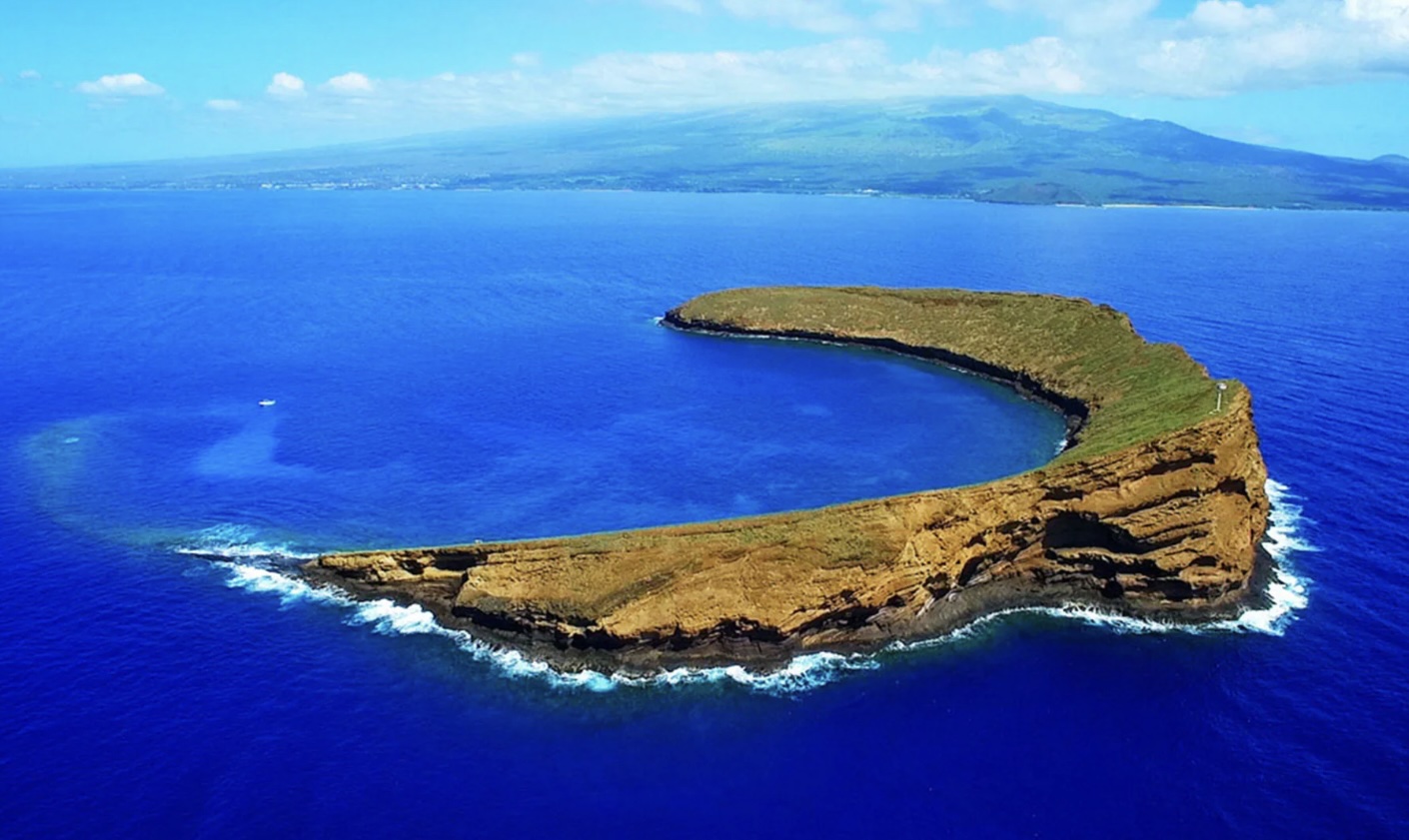
(Island of Molokini with Molokai in the Distance)
Molokai
The fifth largest of the Hawaiian Islands, stretches 38 miles long and 10 miles across at its widest point, creating a landscape that embodies Hawaii's natural beauty without the commercialization found on other islands. Known as "The Friendly Isle," Molokai's history runs deep, beginning with ancient Hawaiian settlements that date back over 900 years. Archaeological evidence at sites like Kawela reveals a complex society that thrived along the southern coast, with remnants of temples (heiau) and traditional land divisions (ahupuaʻa) still visible today. In the 1850s, King Kamehameha V established a significant presence on the island, creating what would later become Molokai Ranch, one of the largest land holdings on the island. Throughout the 19th century, Molokai's history took a poignant turn when in 1866, during Kamehameha V's reign, the Hawaiian legislature designated the isolated Kalaupapa Peninsula as a quarantine site for those afflicted with Hansen's disease (leprosy), a settlement that would operate for over a century until 1969.
The geography of Molokai is dominated by two extinct volcanoes that created distinctly different landscapes. The eastern volcano's catastrophic collapse approximately 1.5 million years ago formed the island's most dramatic feature - the north shore sea cliffs, which rise dramatically to heights of 3,000 feet above the Pacific Ocean. These magnificent formations were designated a National Natural Landmark in 1972 and are recognized as the highest sea cliffs in the world. The collapse created not just vertical walls of breathtaking scale but also carved deep, lush valleys along the northeast coast. The gentle southern slopes, by contrast, extend gradually to the sea, supporting the longest fringing reef in the United States - a 25-mile coral ecosystem teeming with marine life. This geographical contrast between the rugged north and the gentle south has shaped both the island's ecology and its human settlements throughout history.
PRESERVING PARADISE: MOLOKAI'S UNIQUE REAL ESTATE LANDSCAPE
The real estate landscape of Molokai reflects its commitment to maintaining Hawaiian cultural heritage and resisting large-scale tourism development. Unlike other Hawaiian islands, Molokai has intentionally limited commercial growth, with residents actively opposing major resort developments to preserve their traditional lifestyle. The island's housing consists primarily of small communities, rural homesteads, and agricultural parcels. Kawela Plantation, located about 4.5 miles east of Kaunakakai, represents one of the more developed areas, with approximately 120 two-acre agricultural lots established in the early 1980s. Previously part of Molokai Ranch lands, Kawela was once grazing territory before being acquired for residential development. Property on Molokai generally remains more affordable than on other Hawaiian islands, though limited inventory and restrictions on development keep the market relatively small. The island's housing philosophy emphasizes sustainability and connection to the land rather than luxury tourism accommodations.
KAUNAKAKAI: THE HEART OF MOLOKAI'S COMMUNITY LIFE
Kaunakakai, Molokai's largest town, serves as the island's commercial center despite its modest size. Located on the southern shore, this charming community maintains the relaxed, unhurried atmosphere that characterizes the entire island. The town's main thoroughfare, Ala Malama Avenue, extends just a few blocks and features locally-owned shops, restaurants, and essential services rather than tourist attractions. At the heart of town stands the historic Misaki's grocery store, a community fixture since 1921. The Kaunakakai Harbor with its distinctive pier stretching nearly half a mile into the Kaiwi Channel offers both practical transportation connections and scenic sunset views. Every Saturday, the Kaunakakai Farmers Market becomes a vibrant gathering place where residents sell fresh produce, handcrafted items, and local delicacies. What Kaunakakai lacks in modern amenities, it makes up for in authentic Hawaiian character, serving as both an administrative hub and living symbol of Molokai's dedication to preserving traditional Hawaiian culture.
KALAUPAPA: A PENINSULA OF PAIN AND PERSEVERANCE
The Kalaupapa Peninsula tells perhaps the most powerful story of Molokai's past. This isolated landform on the island's northern shore, cut off from the rest of Molokai by 2,000-foot cliffs, became the site of a forced isolation settlement for those diagnosed with Hansen's disease (leprosy) beginning in 1866. Over more than a century, approximately 8,500 people were forcibly relocated to this remote location, legally declared dead, and separated from their families and communities. The settlement comprised two areas - Kalawao on the windward eastern side and Kalaupapa on the western side, which eventually became the primary community due to its more favorable conditions. Despite these harsh circumstances, a remarkable community was formed, aided by dedicated individuals like Father Damien (later canonized as Saint Damien) who arrived in 1873 to provide care and dignity to the residents, ultimately contracting and dying from the disease himself. Mother Marianne Cope and Brother Joseph Dutton also devoted their lives to caring for the community. Today, the peninsula is preserved as Kalaupapa National Historical Park, established in 1980, honoring both the suffering and the resilience of those who lived there. Access remains strictly limited, requiring permits and guided tours, as a small number of former patients still call Kalaupapa home by choice.
TOUCHING THE SKY: MOLOKAI'S WORLD-RECORD SEA CLIFFS
The Molokai sea cliffs stand as one of Hawaii's most awe-inspiring natural wonders. Rising dramatically from the ocean to heights of up to 3,900 feet, these vertical walls along the island's north shore are recognized as the tallest sea cliffs in the world by the Guinness Book of World Records. Their creation was cataclysmic - the northern half of the East Molokai Volcano collapsed approximately 1.5 million years ago, sending an estimated 120 miles of land crashing into the ocean in what geologists identify as one of the largest submarine landslides on the planet. The cliffs stretch for 17 miles from Halawa Valley to Kalaupapa Peninsula, with the section between Pelekunu and Wailau Valleys being the most spectacular. Their remote location has preserved them in a pristine state, with waterfalls like Kahiwa Falls (over 1,700 feet tall) cascading directly into the ocean during rainy periods. These majestic formations can be viewed from several vantage points, including Palaau State Park's Kalaupapa Lookout or, for the adventurous, by boat tours along the coastline that reveal their true immensity. The cliffs not only represent a geological marvel but also embody the raw power and beauty of the Hawaiian Islands in their most elemental form.
All Active and Available MLS Molokai Listings - 112 Properties
43 Active and Available MLS Mokokai Land Listings
Molokai's 10 Most Expensive MLS Listings July 2025
Molokai's Most Expensive Home in Hawaii MLS - $5,330,000
Contributed by Paul Adams, Broker - MegaCapital Hawaii Corp.
:format(webp):quality(80)/u.realgeeks.media/keystosarasota/CheckMark1.png) Exclusive Data Available
Exclusive Data Available:format(webp):quality(80)/u.realgeeks.media/keystosarasota/signup1.png)
:format(webp):quality(80)/u.realgeeks.media/keystosarasota/Hawaiian_Islands_MAP_Homepage.jpg)
:format(webp):quality(80)/u.realgeeks.media/keystosarasota/cyomr1.png)
:format(webp):quality(80)/u.realgeeks.media/keystosarasota/Facebook.jpg)
:format(webp):quality(80)/u.realgeeks.media/keystosarasota/Instagram.jpg)
:format(webp):quality(80)/u.realgeeks.media/keystosarasota/Twitter.jpg)
:format(webp):quality(80)/u.realgeeks.media/keystosarasota/YouTube.jpg)
:format(webp):quality(80)/u.realgeeks.media/keystosarasota/Pinterest.jpg)
:format(webp):quality(80)/u.realgeeks.media/keystosarasota/LinkedIn.jpg)